…More Than Executives?
In consulting and other knowledge industries, the traditional model has always followed a clear path: junior employees process information, middle managers synthesize it, and senior leaders make the final calls. Experience and hierarchy went hand in hand. But that structure is starting to break.
Thanks to generative AI, interns and entry-level analysts now have access to tools that allow them to move faster and smarter than ever before. And in some cases, they’re starting to outperform the people above them.
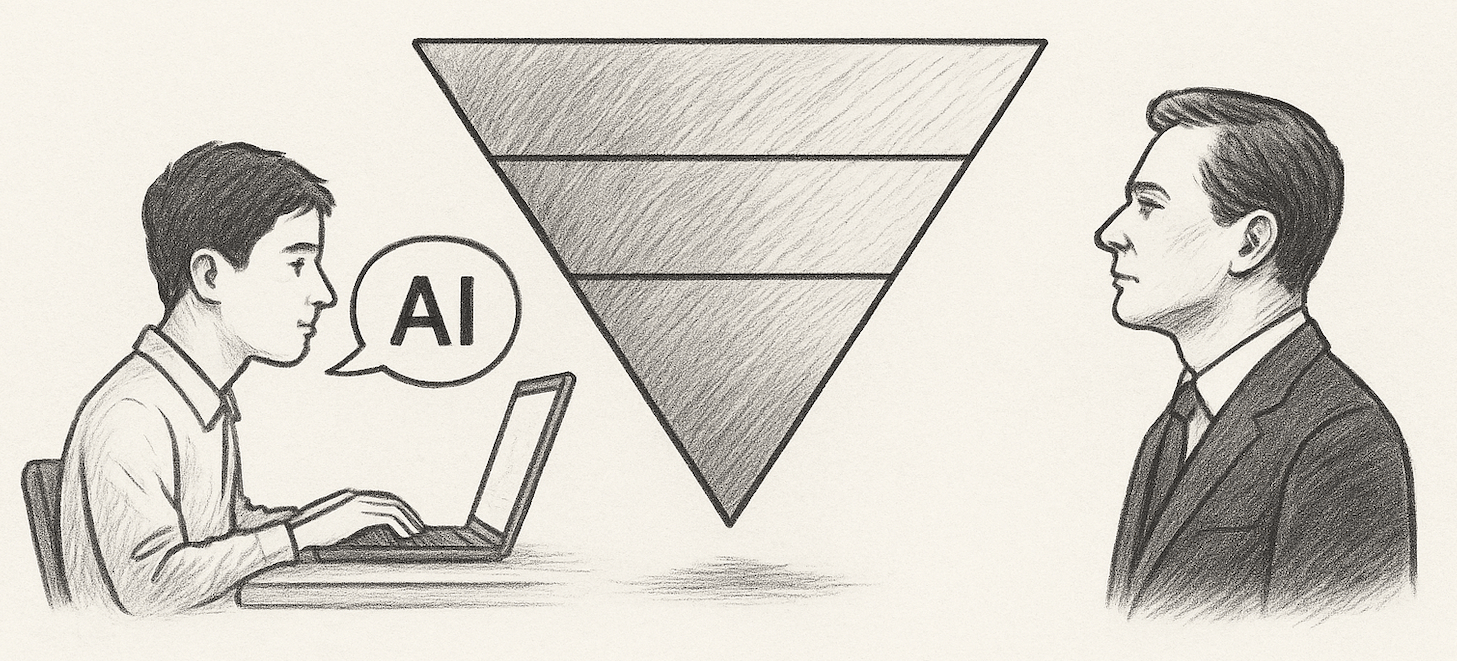
What happens when those at the bottom of the pyramid begin using AI more effectively than those at the top?
The answer could change how companies are run — and who gets to lead.
The rise of the AI-native junior
Juniors entering the workforce today are different. They grew up with digital tools, and many of them are already fluent in using AI platforms like ChatGPT, Claude, and Gemini to generate strategies, write reports, or analyze data in minutes.
They don’t rely on long training sessions or slow approval chains. They get feedback instantly. More importantly, they know how to ask the right questions to get valuable answers. In other words, they speak the language of AI — and that gives them a serious edge.
This doesn’t mean they’re replacing experienced leaders, but it does mean the way value is created inside organizations is shifting.
The experience paradox
Traditionally, experience has been earned over time. Professionals spent years building up knowledge through difficult projects, client challenges, and late nights. That journey helped form the judgment leaders are known for.
But AI shortcuts that process. It gives juniors polished answers without the hard work. They gain speed and output — but not the lived experience that teaches nuance, trade-offs, or when to break the rules.
This creates what some call the “experience paradox”: people who can produce results, but haven’t built the deeper understanding that usually comes with time. In fast-moving environments, that can be both powerful and dangerous.
A challenge to leadership
If a junior can generate a strategy deck in 10 minutes using AI, how does a VP justify three weeks and a team of five?
This is where many organizations are starting to feel a new kind of pressure. If output becomes the main measure of value — and AI boosts output dramatically — seniority alone is no longer enough to lead.
In some cases, executives may start to feel disconnected or even exposed. Their decision-making process, once seen as wisdom, may now be questioned if it isn’t faster or better than what an AI-assisted junior can produce.
The shift isn’t just technical — it’s cultural.
The slow mutation of workplace culture
For decades, the workplace has been more than just a place to get things done. It was also where people built careers, learned from mentors, and grew through shared challenges. In consulting, that meant things like midnight slide decks, difficult clients, and hard-earned trust.
But if AI handles more of the work — especially the difficult parts — that shared struggle may disappear.
When that happens, culture starts to fade. Mentorship moments become rare. Team bonding weakens. And a company becomes just another place to work, not a place to grow.
A new type of leader must emerge
None of this means experienced professionals are obsolete. Far from it. But the ones who thrive will be those who adapt — who learn to use AI as a partner, not a threat.
These leaders won’t just rely on their past. They’ll stay curious. They’ll experiment with new tools. They’ll know when to trust the machine and when to question it. And they’ll be able to teach others how to do the same.
The future of leadership won’t just be about what you know. It will be about how well you can think, prompt, and act — in partnership with AI.
We’re not witnessing the end of experience. We’re witnessing the end of experience as a guarantee of value.
When juniors start using AI better than executives, the whole idea of hierarchy needs to be rethought. Power and influence will depend less on age or title, and more on how well someone can work with intelligent machines.
The pyramid isn’t gone. But it’s no longer stable.
It’s shifting, fast. And the smartest thing leaders can do now — is learn to move with it.
 Jose Larrucea