
What happens when every worker becomes a node in a larger, thinking system—part biological, part digital, all intentional?
More than two years after ChatGPT’s debut disrupted the language of the internet—and the internet of language—artificial intelligence has grown from a spectacle into infrastructure.
This year’s Forbes AI 50 list doesn’t just highlight $142 billion worth of AI ambition; it sketches the blueprint of a new kind of work. What we’re witnessing is not the automation of jobs, but the re-coding of work itself, as intelligence becomes plural, distributed, and deeply entangled with human agency. The old dream of “man versus machine” has quietly evolved into a more collaborative—and provocative—vision: co-intelligence.
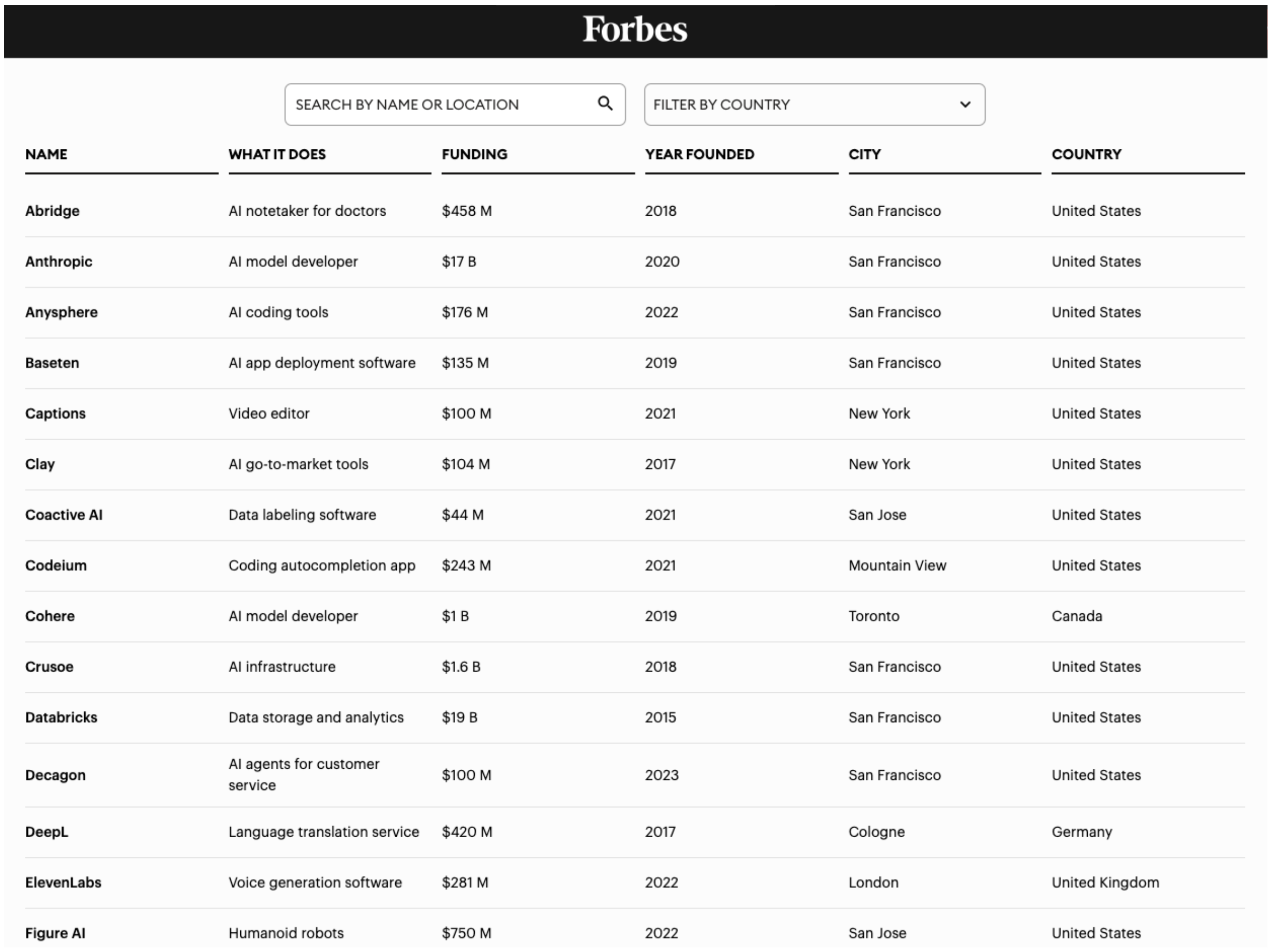
Source: Forbes
This isn’t AI “helping” humans. It’s humans and AI learning to think together, move together, act as one system. It’s what the team at BionicWorkplace.com calls “the merge of humans and Ai-Driven tools”—a design-first framework for blending machine cognition with physical and cognitive human labor. In this emergent model, AI isn’t simply a tool used by the worker. It’s a teammate, a node, sometimes ir could even be a manager. It transforms knowledge workers into augmented operators of insight engines. And increasingly, it turns organizations into intelligent, adaptive systems—learning not just from data, but from their own people, in real time.
Consider Anysphere’s Cursor, an AI programming assistant that helps engineers transform plain language into functioning code. It’s not just accelerating development. It’s redefining the coding process itself as a conversational, semi-autonomous co-design activity. Or take OpenEvidence, which builds AI-summarized medical literature pipelines for clinicians. In a world where practitioners are overwhelmed by torrents of data, this isn’t just a utility—it’s a prosthesis for cognition, enabling faster, safer decisions. Companies like Glean, Harvey, Speak, and Writer do something similar across legal, education, and marketing domains. Each one represents a kind of bionic integration, where AI doesn’t remove the human, but expands the human’s range of motion within increasingly complex information environments.
But tools are only part of the story. Underneath these interfaces is a new culture of work forming—one that’s as much philosophical as it is technological. It’s the ethos behind BYOAI, or “Bring Your Own AI,” a grassroots movement among knowledge workers who are embedding personal agents, prompts, copilots and custom GPTs into their daily routines. It’s not sanctioned; it’s sovereign, and according to Microsoft & Linkedin 2025 annual report this is a trend that already touches 78% of employees who see the benefit of it. It’s also quietly subversive: employees no longer wait for IT to provision solutions—they build their own. Because once a knowledge worker realizes they can build a better assistant in an afternoon than the one corporate has licensed for the year, the power dynamics of productivity shift permanently.
At the heart of many of these companies lies something more profound than just clever software—an emerging idea known as Infinite Knowledge Legacy (IKL). It’s the notion that an organization’s most valuable knowledge—how decisions are made, how problems are solved, how culture is passed on—doesn’t have to walk out the door when someone leaves the job. Instead, that expertise can be captured and turned into smart systems: chatbots, digital guides, and AI advisors that learn from top performers and keep learning. Imagine a context where you don’t just hand off a manual to your replacement—you hand off a digital version of your own thinking process. In this model, wisdom becomes something you can interact with, not just something written down. It’s not just about saving knowledge; it’s about building a legacy that keeps working even when the people who created it have moved on. Knowledge Legacy as such is not a new idea, it dates back to the 1950s with NASA’s project to learn about the problems of hypersonic flight, or later on in the UK by the NHS wanting to address the exodus of knowledge and wisdom from retiring staff – what changes now is the magnitude and possibilities to do it in an infinite way.
This brings us back to the deeper premise: what if every team wasn’t just a collection of people and tools, but a symbiotic mesh of minds—human, artificial, and hybrid—collaborating toward shared objectives? What if your legal team included an AI trained on case law but also on your specific company’s ethics? What if your head of marketing had an agent that predicted the tone of tomorrow’s news cycles based on a custom sentiment model? What if your finance department operated with AI that didn’t just forecast revenue but also interpreted economic risk through the lens of your unique portfolio dynamics?
These are no longer speculative “what-ifs.” They are emerging realities, mapped by the 50 companies on Forbes’ list and accelerated by global moves like Brazil’s judicial AI initiative, where President Lula da Silva last year announced a roll-out of OpenAI tools to alleviate the country’s overloaded court system. As reported in Estadão, this initiative could free hundreds of millions of hours in human labor and potentially save billions in legal expenditures. More importantly, it plants a seed: that AI is not just a corporate advantage but a civic utility—a force multiplier for public systems, human dignity, and governance at scale.
This re-imagining of labor and intelligence—what some call the “post-silo era”—has profound implications for how we measure productivity, value work, and build institutions. The traditional workplace optimized for tasks and time. The Bionic Workplace optimizes for flow and learning. In one, value is extracted from effort. In the other, value is synthesized from interaction—between agents, between platforms, between people and their augmented selves.
And this model only works if the whole system is trustworthy, legible, and reciprocal. It demands new governance structures, privacy regimes, and interface standards. It demands real-time explainability, not just traceability. Because in a world where machines co-author decisions, transparency isn’t a feature—it’s the oxygen of accountability.
The Forbes AI 50 list isn’t just a ranking of the biggest or flashiest companies. It’s more like a map of where humans and machines are starting to work together in powerful new ways. These companies are building the systems that connect human skills with AI capabilities. It’s not about who’s ahead—it’s about who’s shaping the future.
So yes, this is a new assembly line. But unlike Ford’s, it doesn’t build cars. It builds capabilities. It builds networks of intelligence that get smarter, faster, and more contextual with every interaction. And maybe the real question isn’t how fast this future will arrive—but whether we are ready to be part of it, not as users or managers, but as co-creators of a living, thinking, evolving system.
Because when the tools begin to think with us, not just for us, we are no longer just doing work. We (our hands, our minds, our essence) are becoming the infrastructure.
 Jose Larrucea
One thought on “Co-Intelligence and the Rise of the Bionic Workplace”
Comments are closed.